🇫🇮 SPEAKING OPENS DOORS
The Science Behind Finnish Fluency Lab.
Many language learners know much more Finnish than they can actually use.
FROM RECOGNISING IT TO SPEAKING IT
The knowledge is often already there.
Learners may recognise words, understand sentences and complete exercises successfully, yet still freeze when someone speaks to them. The knowledge is often already there, but the speaking part has not yet been activated.
That first step into real conversation can feel like the biggest barrier in language learning.
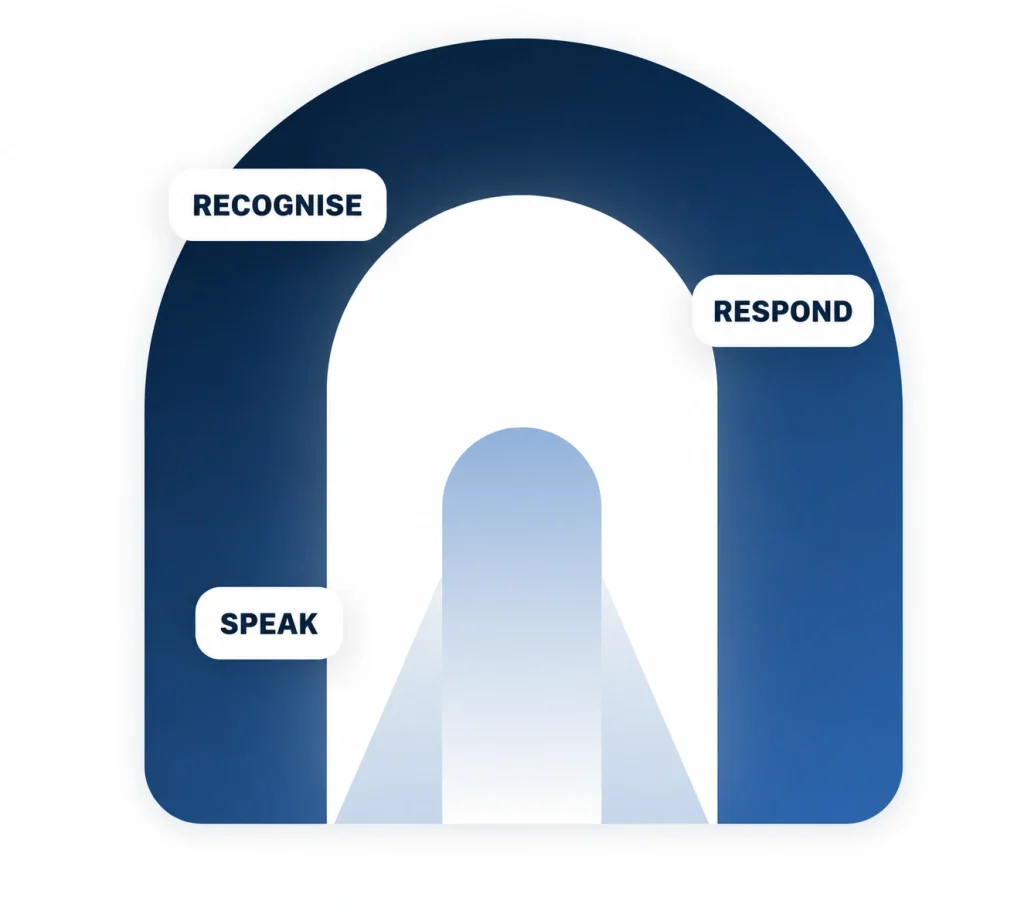
Speaking should not be the prize waiting at the end of language learning.
Speaking is one of the ways language is learned.
That is the central idea behind Finnish Fluency Lab.
🇫🇮 YOU NEED MORE THAN JUST FINNISH AROUND YOU
Turn your immersion into participation
Immersion is often described as surrounding yourself with Finnish (or any other language for that matter) through everyday life, conversations, television, radio, books and other Finnish-language content and you are supposed to magically learn it. This is not quite so.
Many learners already live in Finland and experience Finnish around them every day. They may recognise words, follow parts of conversations and understand much more than they can say, yet still do not speak Finnish, or freeze when it is their turn to answer.
Being surrounded by Finnish creates exposure. It does not automatically create opportunities to retrieve the language and use it yourself.
When you try to speak, the language has to do a different job. You must retrieve the words, choose how they fit together and produce them in real time. This can reveal the difference between Finnish you recognise and Finnish you can access independently.
Finnish Fluency Lab creates a guided immersion in Finnish conversation. You are not only surrounded by the language. You enter the exchange, use Finnish to answer another person, listen to their response and continue the conversation.
This is where immersion becomes participation.
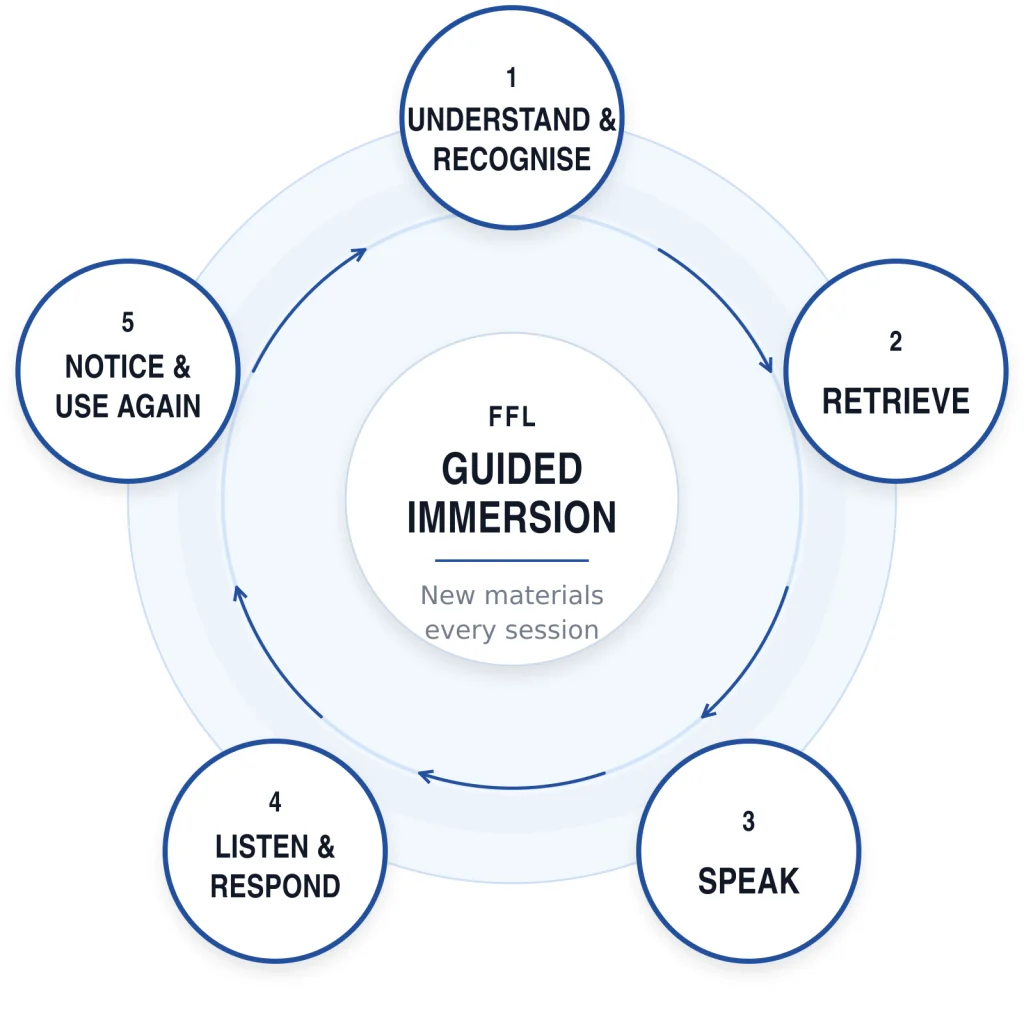
The final stage connects back to the beginning so that the process continues as a loop.
And at FFL each session includes new materials so this loop can continue for as long as you need.
THE FINNISH FLUENCY LAB METHOD
Six Doors to Spoken Finnish
FFL Door 1
Activate your speaking
“Just speak” is easier said than done. Building a sentence in real time means finding the words, organising them and saying them aloud while someone is listening.
Being surrounded by Finnish and entering a conversation are not the same thing. At Finnish Fluency Lab, you take the next step and use the Finnish you recognise to answer another person.
Finnish Fluency Lab makes that first step manageable, with enough support for everyone to join the conversation at their own level.


FFL Door 2
Find your way into the conversation
Each Finnish Fluency Lab speaking prompt gives the group a clear question and structured support.
For beginners, this includes several possible answers. At the more progressed levels, the question is supported by suggested topics that can be used to develop a longer discussion.
The support does more than help you find something to say. It gives you reliable Finnish that has been checked for the situation.
If an ending or structure is different from the one you expected, you can trust the model in front of you, notice the difference and use the correct pattern immediately.
This can help replace a bad habit from before and correct it in real time.
During a session, you can choose how to answer:
- read one of the answers,
- adapt it by changing details or combining ideas,
- or create a completely independent response.
Examples:
Tykkään kahvista.
I-like coffee.
Tykkään kahvista, mutta juon enemmän teetä.
I-like coffee, but I-drink more tea.
A more confident learner may use the question as the starting point for a longer and completely personal answer.
Even reading a supported answer is a step forward. You are producing Finnish aloud, using it to answer another person and taking part in an actual exchange.
FFL JOURNEY: READING → ADAPTING → SPEAKING INDEPENDENTLY
There are no awkward silences at Finnish Fluency Lab. Everyone can take part.
Research on immersion teaching has also found that learners benefit when meaningful communication is combined with noticing, language awareness, practice and feedback. (Lyster, 2004.)
FFL Door 3
Turn recognition into retrieval
Even a short spoken answer activates several processes. Your brain understands the question, retrieves the words, organises them and turns them into speech.
The human brain is remarkably good at learning through use. If you are a beginner, it may feel as though you are simply repeating words, but your brain is already processing the language and hearing how it sounds.
Every attempt to retrieve and produce Finnish helps build the path from recognition to active use.
Research into bilingual speech production shows that speaking a second language involves coordinating language planning with the physical and sensory processes of producing speech. (Simmonds et al., 2011.)

FFL Door 4
Connect with real people
Real conversation adds something an app cannot: another person who listens, responds and sometimes surprises you. Your brain follows the exchange, interprets what is happening and adjusts as the conversation moves.
At Finnish Fluency Lab, you can connect with other learners and become part of a supportive community. You can share the experience of learning Finnish, encourage each other and feel less alone in the process.
That sense of connection grows through the conversation itself. Another learner may give an unexpected answer or ask a follow-up question, and you may find yourself saying:
Ai jaa!
Oh so!
Miksi?
Why?
Voitko toistaa?
Can-you repeat?
Being able to see one another can add another layer to the exchange. Reactions, expressions and small signs of understanding can make the conversation feel more natural and help everyone stay present, comfortable and connected.
Learning alongside people at different stages can also be encouraging. You may think:
“I know where you are at.”
“I was there once before.”
“Wow, that is where I want to be.”
This is how Finnish Fluency Lab becomes more than speaking practice. It becomes a shared learning experience.
Research into online language interaction and listener visual cues also supports the role of visible reactions in understanding and creating a sense of social presence. (Satar, 2013; McDonough et al., 2019.)
Further research into second-language interaction shows that learning is supported by the combination of input, output and negotiation of meaning. When people clarify, repeat or adjust what they say, the conversation itself becomes part of the learning process. (Loewen & Sato, 2018.)
FFL Door 5
Turn gaps into fluency
During a session, you may recognise a Finnish word on the page but struggle to find it while speaking. Trying to express an idea reveals which words or structures are not yet easy to retrieve.
Once that gap becomes visible, your brain is more likely to notice and remember the missing language when you meet it again. You may also compare your answer with the reliable Finnish in the speaking prompt and realise that a word ending or structure needs to change. You have now noticed it, seen the correct form and used it yourself.
That is the road to fluency.
Fluency is not simply knowing more Finnish. It is being able to access and use what you know in a real conversation.

Research supports this connection between speaking and noticing. Producing language aloud can draw your attention to forms you had not fully noticed before and lead to a deeper analysis of the language you hear afterwards. (Zalbidea, 2021.)

FFL Door 6
Put your Finnish into practice
Finnish Fluency Lab gives you regular, structured opportunities to speak Finnish with real people.
Each session includes fresh materials, so you return to the immersion process with new topics and conversations. You understand and recognise, retrieve, speak, listen and respond, notice and use again.
Moreover, the speaking prompts and structured support help you enter the conversation at your own level. The small groups give you time to speak, listen and respond.
Speaking is the key that begins to open the rest of the language.
Each new conversation asks you to retrieve words and structures again and use them in a different way. With regular practice, Finnish that initially takes time and effort to find can become easier and faster to access.
Each session helps you turn the Finnish you know into Finnish you can actually use.
Research into second-language automaticity describes how controlled and effortful language processing can gradually become faster and more automatic through practice. This helps learners move towards fluent, real-time communication. (Suzuki, Maie & Hui, 2025.)

READY TO FIND YOUR FINNISH VOICE?
Turn the Finnish you recognise into Finnish you can use.
Discover how Finnish Fluency Lab helps you use Finnish in real conversations with structured support at your own level.
SPEAK • CONNECT • GROW
STILL HAVE QUESTIONS?
Everything else you may want to know.
RESEARCH
Research references and additional reading
Swain. The Output Hypothesis: Just Speaking and Writing Aren’t Enough. The Canadian Modern Language Review, 1993.
Simmonds et al. Two Tongues, One Brain: Imaging Bilingual Speech Production. Frontiers in Psychology, 2011.
Lyster. Differential Effects of Prompts and Recasts in Form-Focused Instruction. Studies in Second Language Acquisition, 2004.
Loewen & Sato. Interaction and Instructed Second Language Acquisition. Language Teaching, 2018.
Irwin. Audiovisual Speech Perception: A New Approach and Implications for Clinical Populations. Language and Linguistics Compass, 2018.
McDonough et al. The Occurrence and Perception of Listener Visual Cues During Non-understanding Episodes. Studies in Second Language Acquisition, 2019.
Satar. Multimodal Language Learner Interactions via Desktop Videoconferencing Within a Framework of Social Presence. ReCALL, 2013.
Zalbidea. On the Scope of Output in SLA: Task Modality, Salience, L2 Grammar Noticing, and Development. Studies in Second Language Acquisition, 2021.
Suzuki, Maie & Hui. Research Timeline: Automatization in Second Language Learning. Language Teaching, 2025.